
Verify a face,
not a number
people can fake.
FaceTrust AI links a NIN or BVN registry identity to a real, live face — then reuses that same proof to identify people 1:N at a merchant desk, bank branch, or front desk, in under a second.


Name-and-number identity checks stop at a lookup.
Most identity checks in Nigeria today stop there: type in a NIN or BVN, get back a name, and trust that the person standing in front of you is that name. Numbers get shared, stolen, and typed in by someone else entirely. A registry match on its own proves the number is real — it proves nothing about who is holding it.
Name + number lookup
Proves the NIN or BVN exists in the registry. Says nothing about who is holding it right now.
Face-proof link
Every identity link is only confirmed after a live face capture matches the registry's own photo. No match, no link — no name, no number, no unlocked account.
From a number to a verified face, in three steps
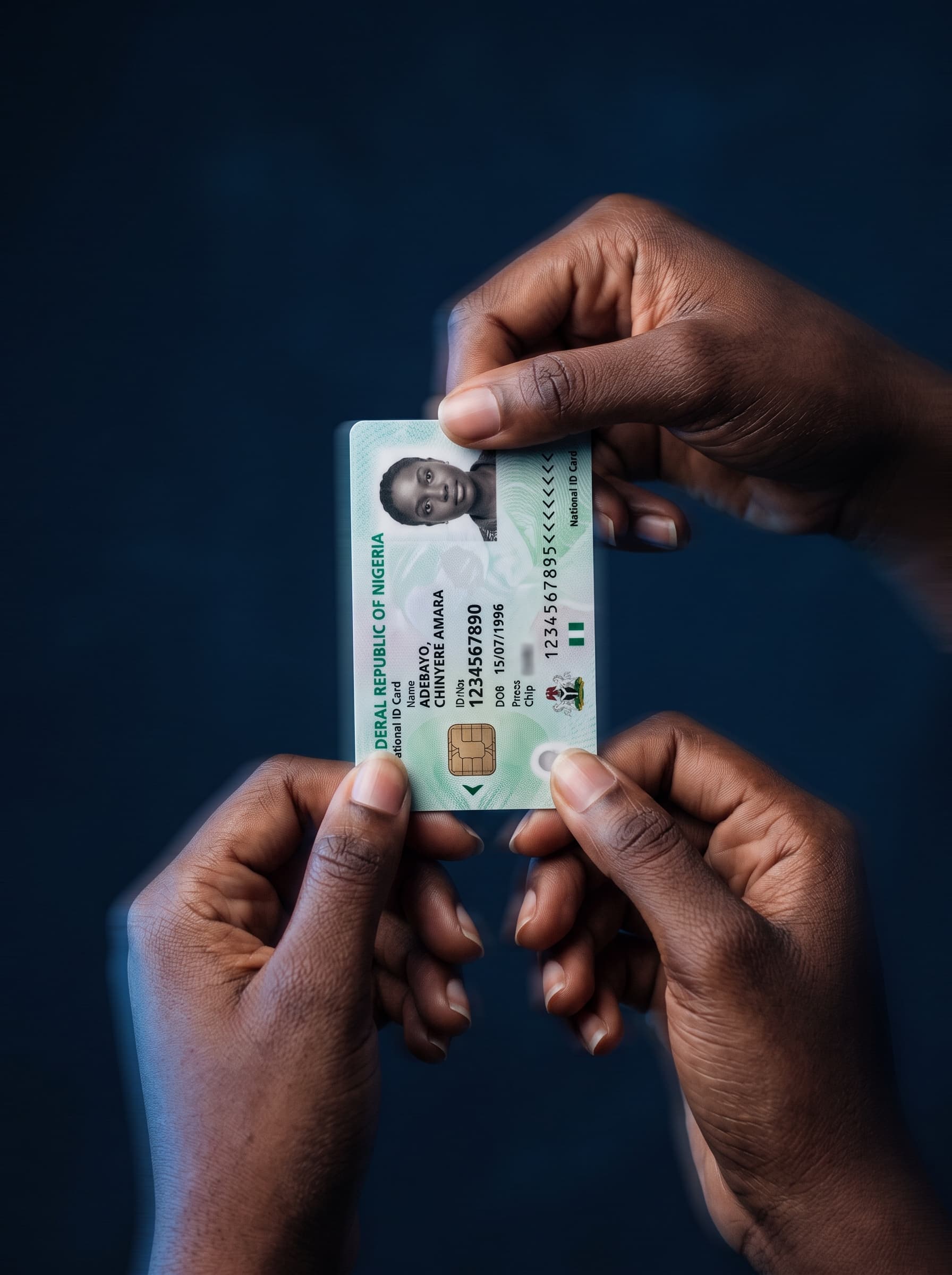
Validate
A NIN or BVN is checked against the national registry. Only a masked name and status come back — no photo, not yet.

98.7%
similarity · threshold ≥ 80%
Prove with a face
A liveness check runs first, then a live capture is compared against the registry photo — a fixed threshold decides, not a person eyeballing two photos.

Checked against 42,318 enrolled faces
✓ Liveness passed
✓ Confidence above threshold
Identify, anywhere, 1:N
At a merchant desk, one capture is compared against every enrolled face — a match, a no-match, or a flagged near-tie, in under a second.
One identity layer, three surfaces
The same verified identity and face embedding powers every surface FaceTrust AI ships — consumers enroll once, and that proof follows them everywhere it's needed.
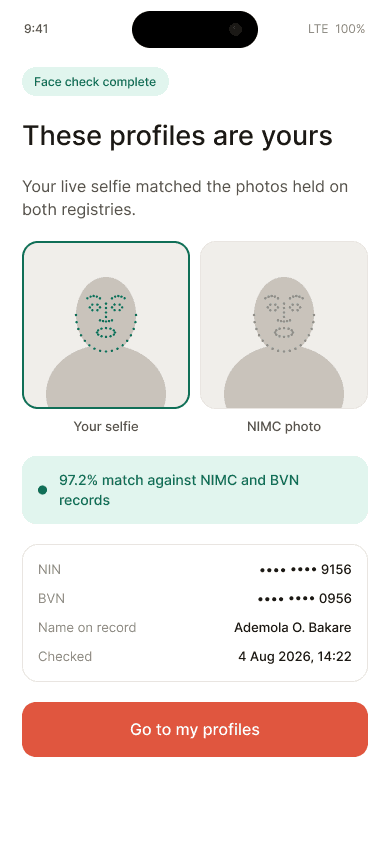
Consumer app
Enroll and manage your identity
Sign up with a phone number and OTP, link your NIN and/or BVN with a face proof, and manage your linked identities, profile, and verification history from one place. Self-verify your own face against your own record any time, and request a review if a check ever goes wrong.
Merchant Desk
Face-only checkout and check-in
A desk-facing app built for speed: an operator signs in, a customer looks at the camera, and the desk shows a match, no-match, or escalation — no queue, no card, no number to key in. Built-in staff management, shift analytics, and a session history of every scan an operator has run.
Open Merchant Desk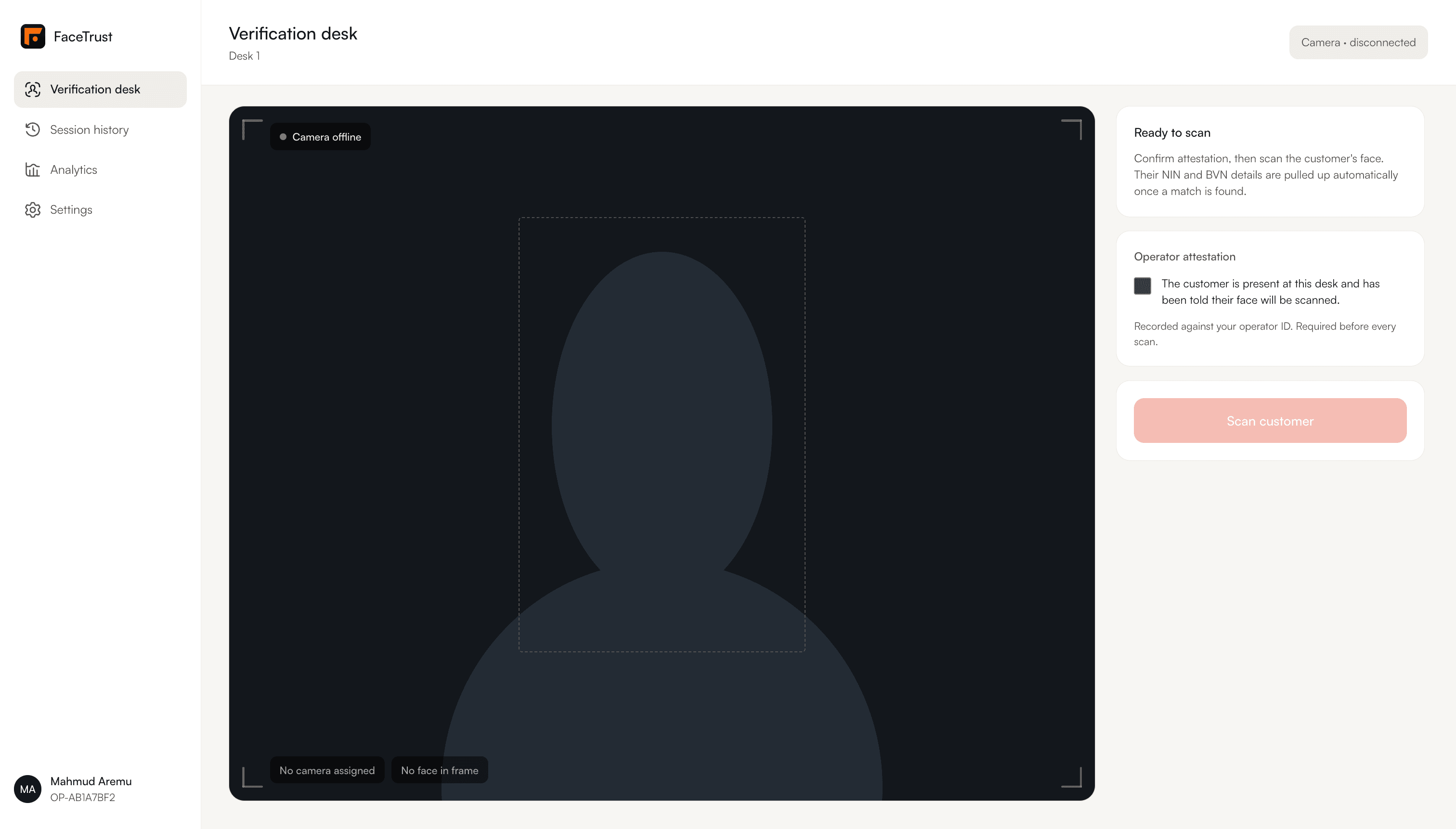
Institution Console
For banks, MFBs, and licensed businesses
Onboard your institution through a KYB flow backed by real CAC registry validation, manage branches and desks, invite and recheck branch managers, review escalated cases, and track billing and compliance renewals — all scoped to your own institution.
Open Institution Console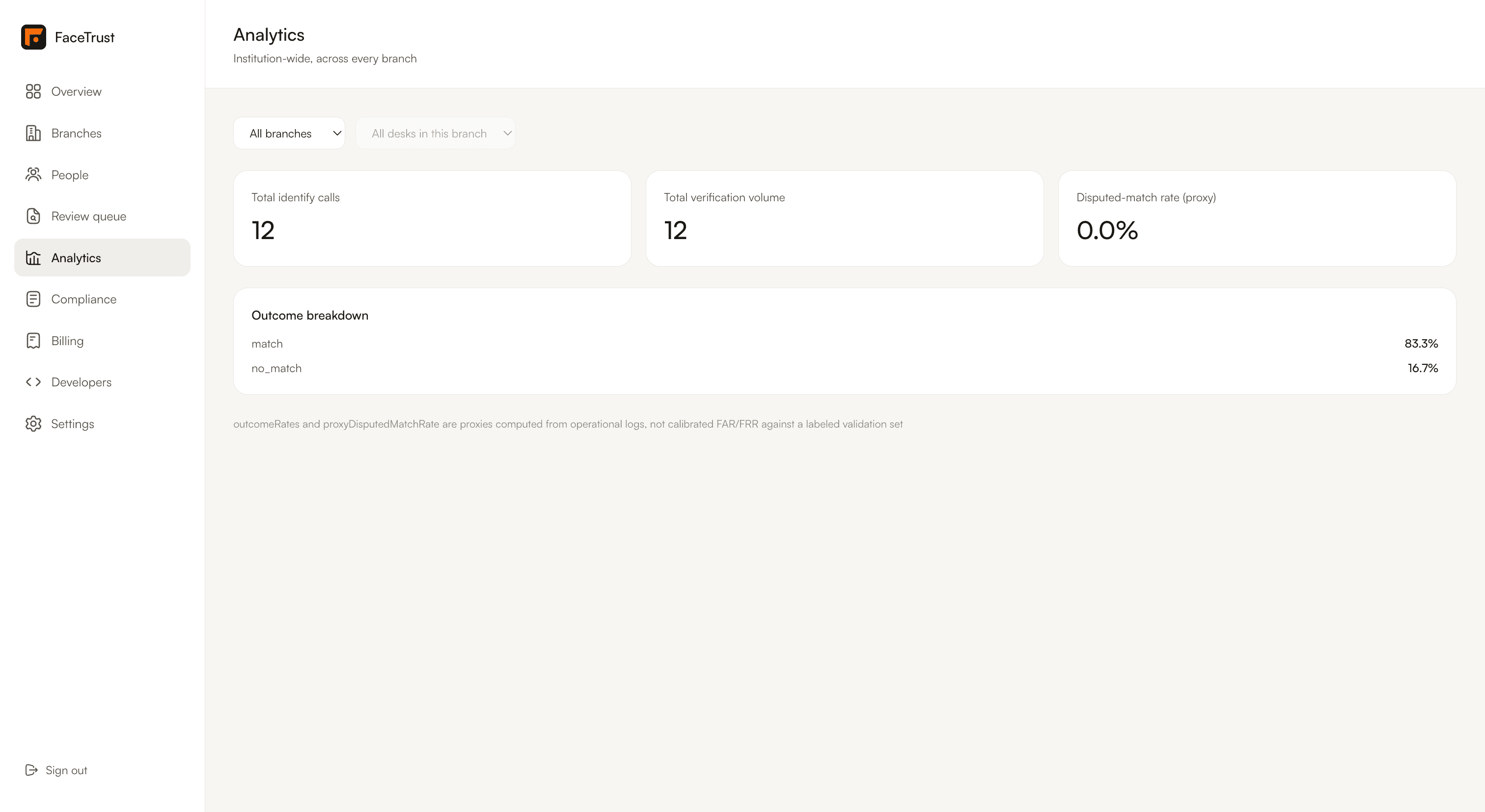
Pricing built around your institution
Verification volume, branch count, and integration depth vary a lot between a single pilot branch and a nationwide rollout — so every plan is quoted, not shelf-priced. Talk to us and we'll size it to what you actually need.
Pilot
One branch, prove it works
Custom quote
- 1 branch, up to 3 desks
- Merchant Desk + Consumer app access
- NIN and BVN identity linking
- Standard email support
Growth
Multiple branches, one institution
Custom quote
- Everything in Pilot
- Unlimited branches and desks
- Institution Console (KYB, staff, compliance)
- Branch-scoped analytics
- Priority support
Enterprise
Full platform, dedicated support
Custom quote
- Everything in Growth
- Custom SLA and onboarding
- Dedicated integration support
- Security review and audit exports
- Named account manager
Built for speed, not just a login screen
These are architecture facts and targets, not marketing round-ups — FaceTrust AI is early, so we'd rather show you how it's built than invent a usage number.
512-d
Face embedding size
one canonical vector per person
<1s
1:N identify target
capture to match, no-match, or near-tie
3
Registries checked
NIN, BVN, and CAC
Target latency budget per stage
Design targets for a single 1:N identify call — not a measured production average.
~440ms total, under the <1s target
Outcome breakdown
Example from the Institution Console analytics screen shown above — one branch, 12 calls.
Built to be trusted with a face
Handling biometric data is a different kind of responsibility. Here's what that means in practice, not just in a policy document.
Photo access is gated
The registry photo is never handed to a client before a live face proof succeeds — validation and photo access are two separate, gated steps.
One embedding per person
Every face is stored as a single canonical embedding per person, not a photo album — old embeddings are archived, never silently overwritten without a trail.
Liveness before matching
Liveness checking runs before any face comparison, so a printed photo or a screen replay is rejected before it ever reaches the matching engine.
Every check is logged
Every comparison, match, and mismatch is logged — accuracy, volume, and dependency health are all visible on live dashboards, not reconstructed after the fact.
Layered staff access
Password, one-time codes, a fresh face check, and — for the most sensitive platform actions — hardware security keys plus a second person's approval.
Biometrics deleted first
Deleting an account removes the biometric record first, before anything else, so no face data outlives the consent that created it.
What pilot teams are telling us
FaceTrust AI is still early — these are real reactions from pilot desks, anonymized by role rather than attributed to a specific name or company we can't yet name publicly.
Verification that used to take a minute at the counter now takes less than a scan. Customers notice the difference immediately.
Branch Operations Lead
Pilot microfinance bank
We stopped worrying about someone else's NIN being typed in at our desk. The face proof closes a gap we didn't have a good answer for before.
Compliance Officer
Pilot institution
Our operators just look at a camera now — no card, no queue, no number to key in wrong. Onboarding a new operator takes minutes.
Desk Supervisor
Retail pilot site
An API-first platform
Every surface FaceTrust AI ships is a thin client over one documented API: identity linking, 1:N identification, profile and audit management, disputes, operator and institution administration, and analytics are all real, versioned endpoints — not screens with logic baked in behind them.
Full API reference, authentication flows, and integration guides are available for any institution or merchant integrating directly.
Read the API docsQuestions we get asked a lot
Is FaceTrust AI a replacement for NIMC or NIBSS?
No. FaceTrust AI is a verification layer that sits on top of the existing NIN and BVN registries — it validates a number against the registry, then adds the face proof step those registries don't do themselves.
What happens if my face doesn't match the registry photo?
The link or check is refused — no name, no number, no unlocked account. Near-tie cases are flagged for manual review rather than auto-approved or auto-rejected.
Do you store my photo?
No photo album. A live capture is compared against the registry photo at proof time, then converted into a single canonical face embedding for your account — the raw registry photo isn't retained by FaceTrust AI after that.
Which institutions can integrate?
Banks, microfinance institutions, and other licensed businesses can onboard through a KYB flow backed by real CAC registry validation, then manage branches, desks, and staff from the Institution Console.
Is there a mobile app?
Today the consumer experience is a mobile-optimized web app — native iOS and Android apps are on the roadmap (see the App Store / Google Play badges above).
How fast is a 1:N identify check?
Under a second end-to-end is the design target, from camera capture to a match, no-match, or flagged near-tie — see the latency breakdown above.
Bring FaceTrust AI to your business
Whether you're a bank, a microfinance institution, a hotel, or a retail chain looking to replace card-and-PIN checkout with a face, we'd like to hear what you're building.
Request enterprise / institution access
For banks, MFBs, hotels, and retail chains ready to pilot FaceTrust AI at a branch or network level.